
A missing tooth can be easy to put off, especially if the space is not painful and you can still chew around it. Maybe the tooth was removed recently, or perhaps the gap has been there long enough that you have gotten used to it. Meanwhile, the teeth, bite, and bone around that space keep changing.
At High Point Dentistry in Elgin, Schaumburg, and Chicago, we help patients understand what those changes can mean and what replacement options may fit. Replacing a missing tooth can help preserve chewing support, limit shifting in the surrounding teeth, and maintain more bone in the area. It can also make the bite feel more balanced again.
Timing can influence how simple or involved treatment becomes later. The longer a tooth is missing, the more likely we are to see changes in the bone or neighboring teeth. Even if you are not ready to replace the tooth right away, it helps to know what is happening before the space changes further.
Missing Teeth? Here’s Why You Shouldn’t Wait for Treatment
When a tooth is gone, the surrounding teeth lose one of the things helping keep them in position. The teeth on either side may begin to lean or drift toward the space, while the tooth above or below it may move farther into the open area. As that happens, the way your teeth meet can gradually change too.
Those changes can affect more than alignment. Food may start catching in new places, certain contacts may become harder to clean, and some teeth may begin taking more pressure than they did before. Over time, the bite can start to feel uneven even if the missing tooth itself never hurt.
Meanwhile, the jawbone in that area begins to remodel because there is no longer a tooth root stimulating it during chewing. That becomes important if you are considering a dental implant, since the amount of available bone can affect how straightforward implant treatment will be.
Shifting Teeth Can Change Your Bite
Teeth naturally support one another, so an open space gives nearby teeth room to move. A neighboring tooth may tip inward, or the opposing tooth may drift farther out because it no longer meets anything during the bite.
As that movement continues, the bite can start distributing pressure differently. You may find yourself chewing more on one side, avoiding harder foods in the area, or noticing that certain teeth hit first when you close your mouth. Those changes can also make some teeth wear faster than others.
Shifting can make home care more awkward too. Tilted teeth may create tighter contacts or irregular spaces where food and plaque collect more easily, which can raise the risk of cavities or gum inflammation around the gap. Replacing the missing tooth can help restore support in that area, improve the spacing, and keep the bite from continuing to change.
Bone Loss Can Make Implant Treatment More Involved
The jawbone responds to the pressure that comes through natural tooth roots during chewing. Once a tooth is removed, that stimulation is gone, and the ridge in that area can gradually become narrower or shorter.
The amount of bone change varies from person to person, but it matters when we are planning a dental implant. Implants need enough healthy bone around them for support, so a site that has been missing a tooth for years may need more preparation than a recently healed space.
In some cases, that means adding a bone graft before the implant can be placed. The graft then needs time to heal before the next step. If implant treatment is something you are considering, checking the site sooner can help us see how much bone is still available.
Chewing on One Side Can Become Your New Normal
Most people adapt quickly after losing a tooth. You may start using the other side more often without thinking about it, especially if chewing near the gap feels awkward.
Over time, that pattern can become part of your routine. The remaining teeth may end up doing more of the work, and some areas can wear faster than others. You may also start avoiding foods that are harder to chew comfortably.
Replacing the missing tooth gives you another working chewing surface and can help distribute pressure more evenly again. That can make meals feel more natural and take some of the extra workload off the other side.
Front and Back Teeth Create Different Problems When Missing
A missing front tooth usually gets attention quickly because it affects appearance, speech, and biting into food. Depending on the space and the surrounding teeth, a dental implant, bridge, or removable appliance may all be options.
A missing back tooth can be easier to ignore because it does not show as much when you smile. However, molars handle a large share of the chewing force, so losing one can push more work onto the remaining back teeth and change how the bite functions.
The location of the missing tooth helps shape the treatment plan. Front teeth often bring appearance and speech into the discussion, while back teeth put more emphasis on chewing support and bite stability. In both areas, replacing the tooth can help restore function and keep the surrounding teeth more stable.
Dental Implants Replace the Missing Tooth Independently
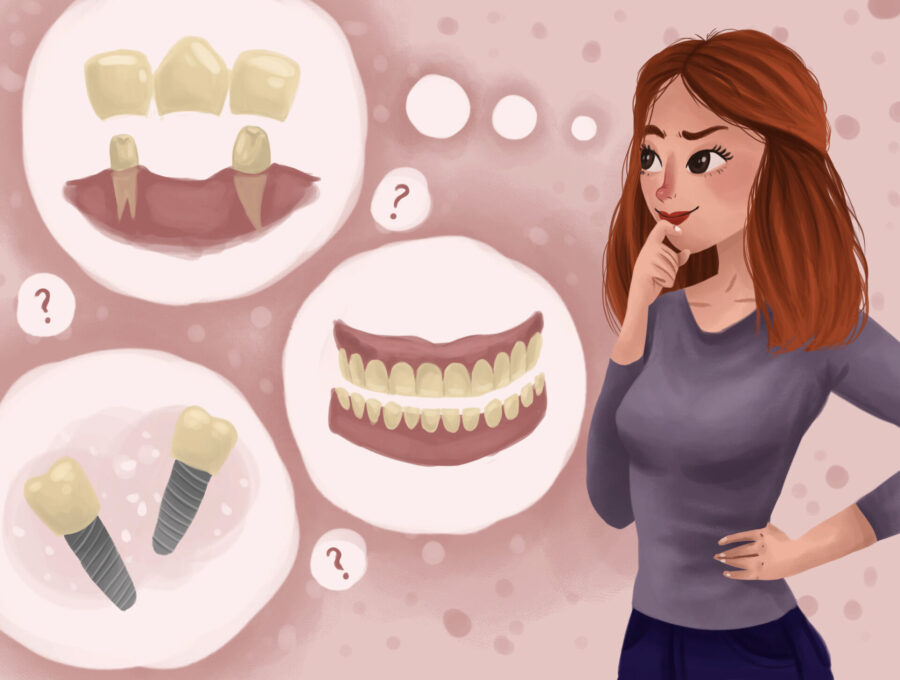
A dental implant replaces the missing root with a small titanium post placed in the jawbone. Once the implant heals, a custom crown is attached on top to replace the visible tooth.
One of the biggest advantages is that the implant stands on its own. We do not have to reshape the neighboring teeth to support it, and you can brush and floss around it much like a natural tooth.
Because the implant transfers chewing pressure back into the bone, it also helps maintain stimulation in that area. For many patients, that combination of stability, function, and independence from the surrounding teeth makes implants worth considering.
A Dental Bridge Uses the Teeth Beside the Space
A dental bridge is another fixed way to replace a missing tooth. The teeth on either side of the gap are prepared for crowns, and the replacement tooth is connected between them.
Once the bridge is secured, it stays in place during eating and speaking. Cleaning underneath it takes a little adjustment, but floss threaders or similar tools can help keep the area clean.
A bridge may be a good fit when the neighboring teeth already need crowns or when implant treatment is not the direction you want to take. The health and strength of those supporting teeth play a big role in whether this option makes sense.
A Partial Denture Can Replace Several Spaces at Once
A removable partial denture can replace one missing tooth or several missing teeth in the same arch. It fits around the natural teeth that remain and is removed for cleaning.
For someone with several missing teeth in different areas, a partial can restore more than one space with a single appliance. It can also be more affordable than placing multiple implants.
The tradeoff is that the appliance comes in and out. Some people adjust to that routine easily, while others prefer a fixed option. We can compare both approaches if you are deciding between them.
The Teeth Around the Space Help Guide the Choice
The condition of the neighboring teeth often helps narrow the replacement options. If those teeth are healthy and untouched, an implant may allow us to leave them that way. If one or both already need crowns, a bridge may fit naturally into the plan.
Bone health matters too, particularly for implants, and the location of the space affects how much pressure the replacement will need to handle. If several teeth are missing in different areas, a partial may give us a more efficient way to restore function.
We also look at how much treatment you want to take on, how quickly you want the tooth replaced, and what fits comfortably within your budget. Those details help us compare the options in a way that feels relevant to your situation.
How Long the Tooth Has Been Missing Can Change the Plan
A recently removed tooth may leave behind a ridge with good height and width. Over time, that ridge can remodel, and the neighboring teeth may begin moving toward the space.
If several years have passed, we may see more bone loss, less room for a replacement, or movement in the opposing tooth. That can affect whether an implant fits directly into the site or whether grafting or another step may be needed first.
A long-standing gap can still be treated. We just need to see how much bone remains, how the surrounding teeth have moved, and how much room is still available for the replacement.
Waiting Can Add Steps and Cost
Tooth replacement already involves an investment, and waiting can sometimes make the plan more involved. If the bone thins, neighboring teeth shift, or the space narrows, extra treatment may be needed before the replacement can be placed.
That could mean bone grafting, orthodontic movement, or a different restoration than the one you originally had in mind. Those added steps can increase both the timeline and the overall cost.
For that reason, it can help to have the space checked even if you are not ready to move ahead right away. You can learn whether the area is changing and whether waiting is likely to affect the options you are considering.
What if the Tooth Was Just Removed?
A recently extracted tooth needs time to heal, and the replacement timeline depends on why the tooth was removed, how healthy the surrounding bone is, and which treatment you are considering.
In some cases, an implant may be placed close to the time of extraction. In others, the area heals first before implant placement or another restoration begins.
The timing can vary quite a bit from one site to another. If replacement is already part of the plan, we can look at the healing area and let you know when the next step makes sense.
What if the Tooth Has Been Missing for Years?
You can still replace a tooth even if the gap has been there for a long time. We begin by checking the bone, the neighboring teeth, and how much space remains.
Imaging helps us see whether the bone can support an implant, while the exam shows us whether the surrounding teeth have shifted. Sometimes the treatment is still fairly simple, and other times grafting or a different replacement may be the better fit.
The key is working with the mouth as it is now. From there, we can compare the options that still fit the space well.
What Happens at a Missing Tooth Consultation?
We start by examining the space, the neighboring teeth, and the way your bite comes together. If you are considering an implant, imaging may also be used to look at the amount and shape of the bone in that area.
From there, we can compare the replacement options that fit. That may include an implant, a bridge, a partial denture, or another restorative plan depending on how many teeth are missing.
We can also go over timing, maintenance, and cost so you know what each option would involve day to day. By the end of the visit, you should have a much clearer idea of what can be done and what each path would look like.
Missing Tooth Treatment at High Point Dentistry in Elgin, Schaumburg, & Chicago, IL
If you are missing a tooth, we can help you figure out which replacement options fit the space and how the surrounding teeth and bone are doing. At High Point Dentistry in Elgin, Schaumburg, and Chicago, our team offers dental implants and other restorative options based on your oral health, goals, and budget.
Whether the tooth was removed last month or has been missing for years, it is worth taking a look at the area. We can check the bone, neighboring teeth, and bite, then talk through the options in a way that feels clear and manageable. Schedule a visit with High Point Dentistry in Elgin or Schaumburg—we’d be glad to help you get that space taken care of!
Image from Authority Dental under CC 2.0